
Surface and edges
Dirt, oil spotting, and vegetation creeping in at the edges all stop sealer from bonding. We check how much cleaning and edge work the surface needs, since that is often the difference between a coat that holds and one that lifts.
Serving Minneapolis, Minnesota & surrounding areas
Mon–Fri 8am–6pm · Sat 9am–2pm
Sealcoating for Brooklyn Park driveways and shared drive lanes, with the access plan worked out before the first gallon goes down.
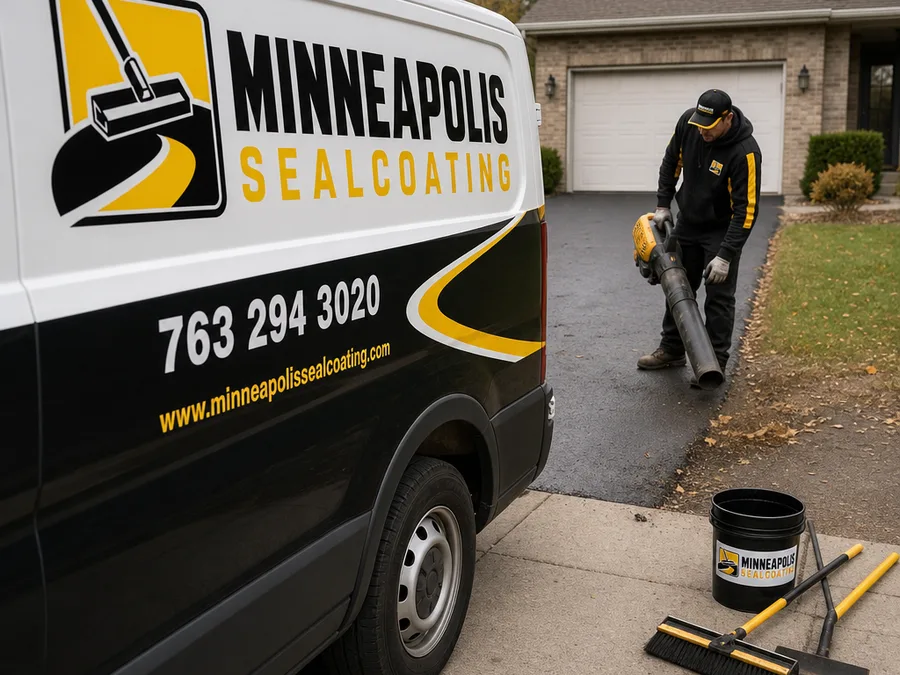
On a single driveway the plan is simple. On a shared lane with several households, the question is where everyone parks while the coating sets.
Most of the Brooklyn Park work we are asked about is residential: a driveway, an apron, sometimes a short lane serving a handful of townhomes. The coating itself is the same work in all three cases. What changes is the sequencing, because a lane nobody can use for a day is a real problem for the people who live on it.
So we start by walking the surface with you and asking how it gets used. Which stalls are occupied overnight, where delivery and trash vehicles turn, whether there is a second way out. That conversation decides whether the job runs in one pass or in sections, and it is easier to have before the scope is written than after.
We work from our shop at 2010 E Hennepin Ave in Minneapolis and travel to Brooklyn Park for the day. That matters in one practical way: we plan to finish what we start, rather than leaving a half-coated lane overnight because a return trip was easier for us.
A number given over the phone is a guess. These are the things we check in person, because each one changes either the scope or the schedule.
Dirt, oil spotting, and vegetation creeping in at the edges all stop sealer from bonding. We check how much cleaning and edge work the surface needs, since that is often the difference between a coat that holds and one that lifts.
We note where vehicles sit and where they turn. Turning tires polish asphalt and wear a coating faster than straight traffic, so those areas get attention in the plan rather than a uniform pass and a hope.
Where a lane cannot close for a full day, we look at whether it splits sensibly into halves with a usable route through. Some layouts allow it cleanly and some do not, and we will tell you which one yours is.
Areas that hold water after rain are worth knowing about before coating. Sealer is not a leveling product, so a low spot stays a low spot and we would rather you hear that from us first.
This is the shape of a sectioned job on a shared lane. A single driveway follows the same steps with far less coordination.
You get the date, the sections, and where each vehicle should sit the night before. Residents who know the plan in advance are the single biggest factor in a job running smoothly.
The section is cleared, swept, and cleaned, with edges cut back where growth has crept in. Trouble spots and open cracks get addressed before anything is coated.
Garage aprons, sidewalks, and concrete edges are masked. Landscaping along the lane gets covered where overspray is a risk.
Sealer goes down at the specified rate, then the section stays closed through the cure window. You get specific guidance on when to walk it and when vehicles can return.
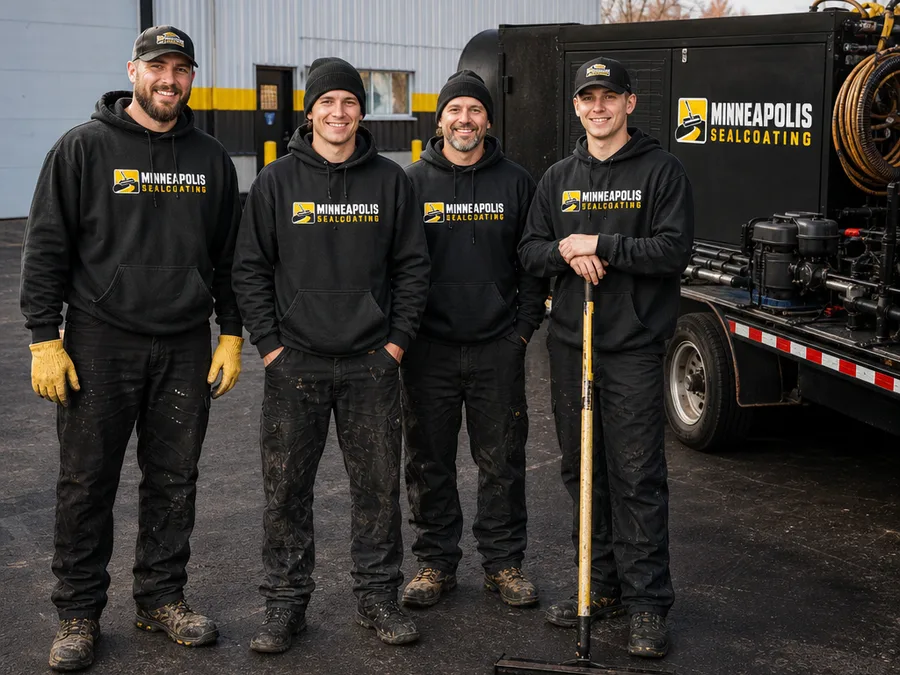
We are based at 2010 E Hennepin Ave, Suite 4, Minneapolis, MN 55413, and Brooklyn Park is part of the area we cover from there. There is no separate office or local crew: the same people who do the work in Minneapolis do it here.
Call (763) 294-3020 to talk through the pavement, or request an estimate and we will arrange a time to look at it.
Request an EstimateThe ranges below are the ones published across this site. They hold for Brooklyn Park work, and a site visit is what turns a range into a number.
Expect roughly $0.20 to $0.50 per square foot for residential and light commercial sealcoating. A small one-car driveway commonly lands in the $200 to $350 range, while larger driveways and small lots typically run from about $500 to $1,500 and up depending on layout and condition.
Shared lanes sit at the upper end more often than single driveways do, not because the coating costs more per foot, but because sectioning the work and protecting more edges takes longer. We confirm the figure after measuring and checking the pavement.
The questions below come up most often on shared and multi-household pavement. An on-site review gives you the specifics for your property.
On most shared lanes, yes, if the layout allows a usable route while one section cures. We confirm that on site before committing to it, because promising access we cannot deliver is worse than closing the lane for a day.
We give you the dates, sections, and parking instructions in writing so you can circulate them. For managed properties we can work to whatever notice period your residents expect.
Most sealed surfaces take vehicle traffic within about 24 to 48 hours, depending on sun, humidity, and temperature. You get a cure plan for your specific site rather than a general figure.
We seal up to the edge and mask the concrete so the line stays clean. Where the apron itself is damaged, that is a repair conversation and we will point it out rather than coat over it.
Tell us about the pavement, then we can discuss the next practical step. Our office is at 2010 E Hennepin Ave, Suite 4, Minneapolis, MN 55413.
Call Now (763) 294-3020